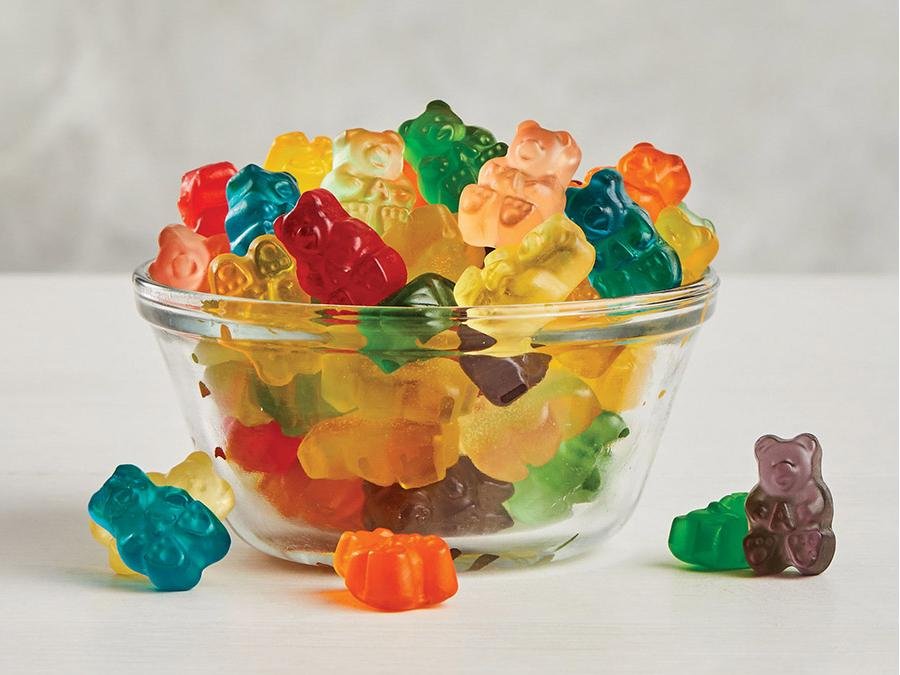
Bite into a sour gummy worm and you expect an immediate tart punch. The answer is fumaric acid (E297, CAS 110-17-8), a food-grade dicarboxylic acid with properties no other acidulant can match simultaneously: 1.8× the sourness intensity of citric acid per gram, near-zero hygroscopicity (won’t absorb moisture and ruin dry coatings), and a low solubility profile (0.63 g/100mL H₂O at 25°C) that creates a slow-release tartness layer on your tongue. While most people only encounter fumaric acid on a sour candy ingredient label, it’s one of the most strategically versatile acids in the food industry — also used in powdered beverages, flour tortillas, refrigerated biscuit dough, wine stabilization, and meat processing.
Key Takeaways
- Sourness Powerhouse: Fumaric acid delivers 1.8× the sourness intensity of citric acid on a per-gram basis (pKa₁ ≈ 3.02 vs. citric pKa₁ ≈ 3.13). Candy makers can reduce acidulant weight by ~30–40% and still hit target tartness levels.
- Non-Hygroscopic = No Clumping: Unlike citric and malic acids (which absorb moisture from air and cause powdered coatings to clump), fumaric acid is essentially non-hygroscopic. This is the #1 reason it’s used in sour sanding sugar and dry-mix products.
- Slow-Release Sourness Profile: Solubility of just 0.63 g/100mL at 25°C means fumaric acid dissolves gradually on the tongue, creating a 15-30 second tartness layer rather than a 2-second citric acid spike.
- Dual Preservative Action: Fumaric acid lowers pH below 4.0 AND its undissociated molecules penetrate microbial cell membranes (the “proton force” mechanism) — providing antimicrobial efficacy superior to citric acid at equivalent pH.
- Beyond Candy — 6 Other Applications: Powdered drink mixes, refrigerated doughs (slow leavening acid), flour tortillas (preservation), wine (malolactic fermentation inhibitor), meat processing (water-holding), and pet food (clean-label preservative).
Fumaric acid in food and sour candy
What Is Fumaric Acid?
Fumaric acid (trans-butenedioic acid, C₄H₄O₄, MW 116.07) is a dicarboxylic acid with a trans-configured double bond — this geometry is key to its unique functional properties. It occurs naturally in Fumaria officinalis (earth smoke herb), Boletus mushrooms, Iceland moss, and trace amounts in papaya, pear, and plum. It’s also an intermediate in the Krebs (citric acid) cycle — your own body produces and consumes it during energy metabolism.
Industrial production: Most food-grade fumaric acid is manufactured via catalytic isomerization of maleic acid (its cis-isomer) in aqueous solution at ~130–150°C. The resulting white crystalline powder has a melting point of ~287°C (sublimes) and is recognized as GRAS by the FDA (21 CFR 172.350, 1979) and approved as E297 in the EU.
| Property | Value |
|---|---|
| CAS Number | 110-17-8 |
| Molecular Formula | C₄H₄O₄ (HO₂CCH=CHCO₂H) |
| pKa₁ / pKa₂ (25°C) | 3.02 / 4.38 |
| Solubility in H₂O (25°C) | 0.63 g/100mL |
| Solubility in H₂O (100°C) | 9.8 g/100mL |
| Melting Point | ~287°C (sublimes) |
| Relative Sourness (vs. Citric = 1.0) | ~1.8 |
| Hygroscopicity | Essentially non-hygroscopic |
| Regulatory | FDA GRAS (21 CFR 172.350) / EU E297 / JECFA |
How Fumaric Acid Works in Sour Candy: A Three-Layer System
Layer 1 — Initial Impact (pH Drop): As a strong dicarboxylic acid, fumaric acid rapidly donates protons (H⁺) upon contact with saliva, dropping local pH to ~2.5–3.0 — the threshold at which human sour taste receptors (PKD2L1 ion channels) are maximally activated.
Layer 2 — Sustained Release (Solubility Control): With only 0.63 g/100mL cold-water solubility, undissolved fumaric acid microcrystals remain on the tongue and gums, slowly releasing tartness over 15–30 seconds. This creates the “long sour” profile — it doesn’t hit and vanish like citric acid’s instant spike.
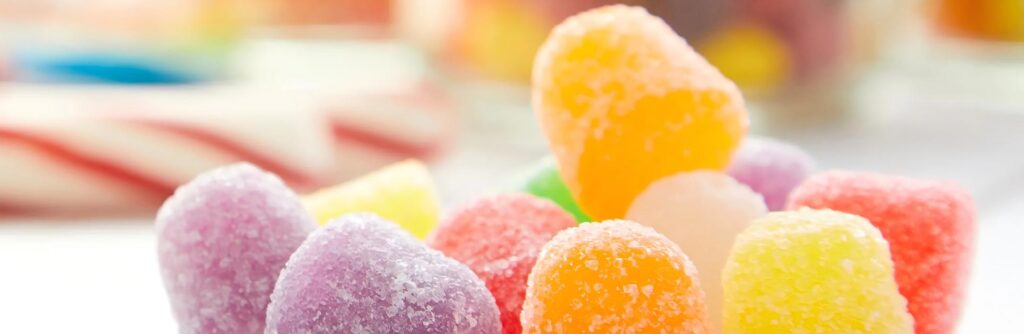
Layer 3 — Dry Coating Integrity (Non-Hygroscopicity): The #1 practical reason manufacturers choose fumaric acid over citric/malic for sour coatings: it doesn’t pull moisture from the air. Citric acid-coated gummies sweat, clump, and lose their sour sanding layer within days in humid packaging. Fumaric acid-coated candies stay dry, free-flowing, and intensely sour on the surface for months.
Why fumaric acid creates lasting sour flavor
Acidulant Blending: Building a Multi-Phase Sourness Curve
Professional confectioners rarely use a single acid. The goal is to build a sourness curve with distinct phases — an immediate hit, a mid-palate body, and a lingering finish. Here’s how fumaric acid fits into each blending strategy:
| Blend | Role of Each Acid | Result | Common Ratio |
|---|---|---|---|
| Citric + Fumaric | Citric: instant 2-second spike (pKa₁=3.13, highly soluble) Fumaric: 15-30 second sustained body (pKa₁=3.02, low solubility) | Classic two-phase sourness — hits hard then keeps going | ~3:1 to 4:1 (citric:fumaric) |
| Malic + Fumaric | Malic: smooth rounded “apple” tartness with fast onset Fumaric: sharp clean tail that prevents flavor collapse | “Premium sour” profile — less abrasive than citric blends | ~2:1 to 3:1 (malic:fumaric) |
| Citric + Malic + Fumaric | Citric: flash hit / Malic: rounded mid-palate / Fumaric: controlled finish | Three-phase sourness — the “holy grail” for extreme sour candies | ~2:1:1 |
Practical Note — The Solubility Trap: Fumaric acid’s most common formulation mistake is attempting to dissolve it in cold water. At 25°C, only 0.63 g dissolves per 100mL — it clumps and sinks. The solution: either pre-dissolve in hot liquid first (solubility jumps to 9.8 g/100mL at 100°C), or blend it with dry sugar/citric acid powder before adding any liquid to the batch. This is a mistake that has ruined countless test kitchen batches.
Comparing fumaric acid to other sour candy acids
| Dimension | Fumaric Acid | Citric Acid | Malic Acid | Phosphoric Acid |
|---|---|---|---|---|
| Relative Sourness | ~1.8× | 1.0 (baseline) | ~1.2× | ~0.9× |
| pKa₁ (25°C) | 3.02 | 3.13 | 3.40 | 2.15 |
| Solubility (g/100mL, 25°C) | 0.63 | 59.2 | 55.8 | Miscible |
| Hygroscopicity | Non-hygroscopic | High (critical RH ~75%) | Moderate to High | N/A (liquid) |
| Sourness Duration | 15-30 sec (slow release) | 2-5 sec (instant spike) | 5-10 sec (smooth fade) | Instant, sharp |
| Flavor Profile | Strong, clean, sharp — “industrial tart” | Bright, fruity — universal | Smooth, round, “apple-like” | Flat, inorganic “bite” |
| Cost per Unit Acidity | Lowest — ~30-40% less acid needed | Medium — benchmark price | Highest — 1.5-2× citric price | Lowest absolute cost but label-unfriendly |
| Antimicrobial Efficacy | Strong (proton force mechanism + pH drop) | Moderate (pH only) | Weak (highest pKa) | Strong (very low pH) |
| Clean-Label Compatibility | Excellent — “fumaric acid” / E297 | Accepted — but “citric acid” may still be perceived as additive | Best — “apple acid”, strong natural perception | Poor — widely seen as “chemical” |
| Regulatory | FDA GRAS / EU E297 / JECFA | FDA GRAS / EU E330 | FDA GRAS / EU E296 | FDA GRAS / EU E338 |
| Best For | Powdered coatings, dry mixes, long-shelf-life confectionery | Aqueous beverages, general acidulation | Hard candy, sugar-free gum, premium fruit flavors | Cola-type carbonated beverages only |
Bottom Line for Confectioners: If your candy needs a sour coating that stays dry and intense for 6+ months on shelf, fumaric acid is the only viable choice. Citric acid will ruin the coating within days. Malic acid will cost 1.5-2× more. Phosphoric acid won’t work in a solid product.
FAQ
Why is fumaric acid used in sour candy instead of citric acid?
Three reasons: (1) Fumaric acid is ~1.8× more sour per gram — less acid achieves the same tartness, saving cost. (2) It’s non-hygroscopic — sour coatings stay dry and free-flowing for months, whereas citric acid coatings clump within days. (3) Its low solubility (0.63 g/100mL at 25°C) creates a 15-30 second slow-release tartness rather than citric acid’s 2-second spike.
Is fumaric acid safe to eat?
Fumaric acid has been designated Generally Recognized as Safe (GRAS) by the FDA since 1979 (21 CFR 172.350) and is approved as food additive E297 in the EU. It is a natural intermediate in the human Krebs cycle — your body produces and metabolizes it daily during energy production.
How much fumaric acid should I use in a recipe?
As a rule of thumb, reduce your citric acid amount by 30-40% when substituting with fumaric acid (it’s ~1.8× more sour). Always start with less and taste-test — overdoing it produces an unpleasantly harsh, chemical sourness. Start at 60% of your citric acid weight and adjust upward.