
When fumaric acid reacts with Baeyer’s reagent, it transforms into a diol known as racemic tartaric acid. This reaction demonstrates the alteration of the double bond in fumaric acid, enhancing its utility in various applications. Racemic tartaric acid is commonly found in food products, highlighting the significance of Fumaric Acid For Foods. Additionally, Fumaric Acid in Juice showcases its versatility and importance across different sectors.
Key Takeaways
- Fumaric acid mixes with Baeyer’s reagent and makes racemic tartaric acid, which is a diol with two hydroxyl groups. The reaction turns the solution from purple to brown, which shows the double bond has reacted. It is important to know that fumaric acid has a trans configuration, because this stops meso-tartaric acid from forming. You can test the melting point and look at the stereochemistry to make sure racemic tartaric acid was made. To avoid mistakes, learn about the reaction types and why stereochemistry matters.
Fumaric Acid and Baeyer’s Reagent Reaction
Observable Changes
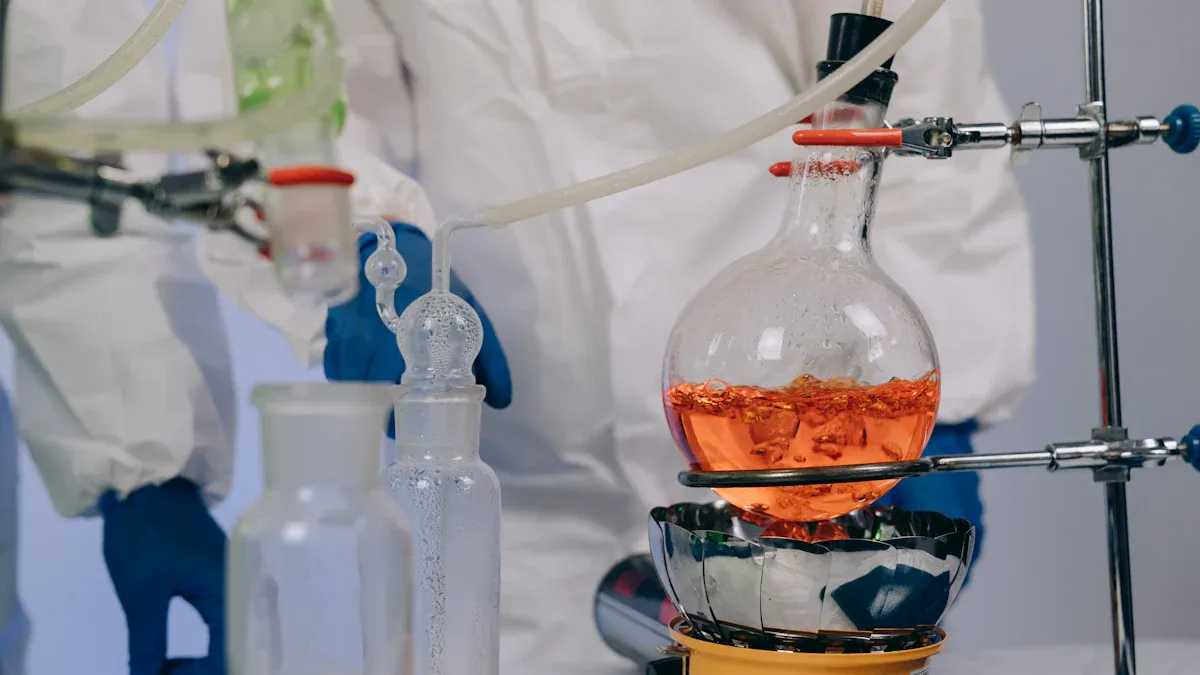
A chemist mixes Baeyer’s reagent with fumaric acid. The solution starts out purple. This is because Baeyer’s reagent has potassium permanganate. As the reaction happens, the purple color goes away. The solution turns brown instead. This change means the permanganate ions are reacting. They react with the double bond in fumaric acid. A brown solid called manganese dioxide appears. This shows the reaction is working. Students and scientists watch for this color change. It helps them know the double bond has reacted.
Product Formed: Racemic Tartaric Acid
The reaction makes a diol. This means two hydroxyl groups join the acid. They add across the double bond. The product is racemic tartaric acid. It has two chiral centers. Racemic tartaric acid has two mirror-image forms. Both forms are present in equal amounts. The reaction is called hydroxylation. This is because it adds hydroxyl groups to the molecule.
There are other ways to make a diol from fumaric acid. One way is the oxa-Michael addition. This uses alcohols and special helpers called catalysts. Primary and allylic alcohols work well for this. Chemists use catalysts like proazaphosphatrane. They also use trialkylphosphines, such as trimethylphosphine. These help the reaction happen easily. These methods show there are many ways to make diols from fumaric acid.
Making racemic tartaric acid from fumaric acid changes the molecule. It shows how reactions can change what molecules look like and do. Scientists learn how to make new products from simple acids by studying these reactions.
Chemical Reasoning and Mechanism
Why Fumaric Acid Reacts
Fumaric acid acts in special ways during reactions. Its trans configuration means the carboxylic groups are on opposite sides. This setup changes how the reaction works. The trans configuration stops meso-tartaric acid from forming with Baeyer’s reagent. Instead, racemic tartaric acid is made. The two carboxylic groups let the acid react in more than one spot. The double bond helps the acid react with Baeyer’s reagent. This makes new products. The table below shows how the structure affects reactivity:
| Structural Feature | Implication for Reactivity |
|---|---|
| Trans configuration | Stops meso-tartaric acid from forming with Baeyer’s reagent |
| Two carboxylic groups | Gives more places for chemical changes |
| Carbon-carbon double bond | Lets the acid join with other monomers |
Baeyer’s reagent adds hydroxyl groups to the double bond. This changes the acid’s stereochemistry. Two new chiral centers are made. The products show how the acid’s shape controls what forms.
Mechanism Compared to Diels-Alder Reaction
Some students think this reaction looks like a diels-alder reaction. The diels-alder reaction uses a diene and a dienophile to make a ring. Fumaric acid can be a dienophile in some cases. But with Baeyer’s reagent, the reaction does not follow diels-alder rules. Baeyer’s reagent uses hydroxylation, not cycloaddition. The diels-alder reaction’s stereochemistry depends on the diene and dienophile’s positions. In this reaction, the trans configuration of fumaric acid decides the stereochemistry. The products show why stereochemistry matters. No ring is made in this reaction. So, it is not the same as the diels-alder reaction. Students should know these two reactions follow different rules for stereochemistry.
Tip: Always look at the starting acid’s stereochemistry before guessing the products. This helps you tell the difference between reaction types.
Practical Interpretation in the Lab
Confirming the Result
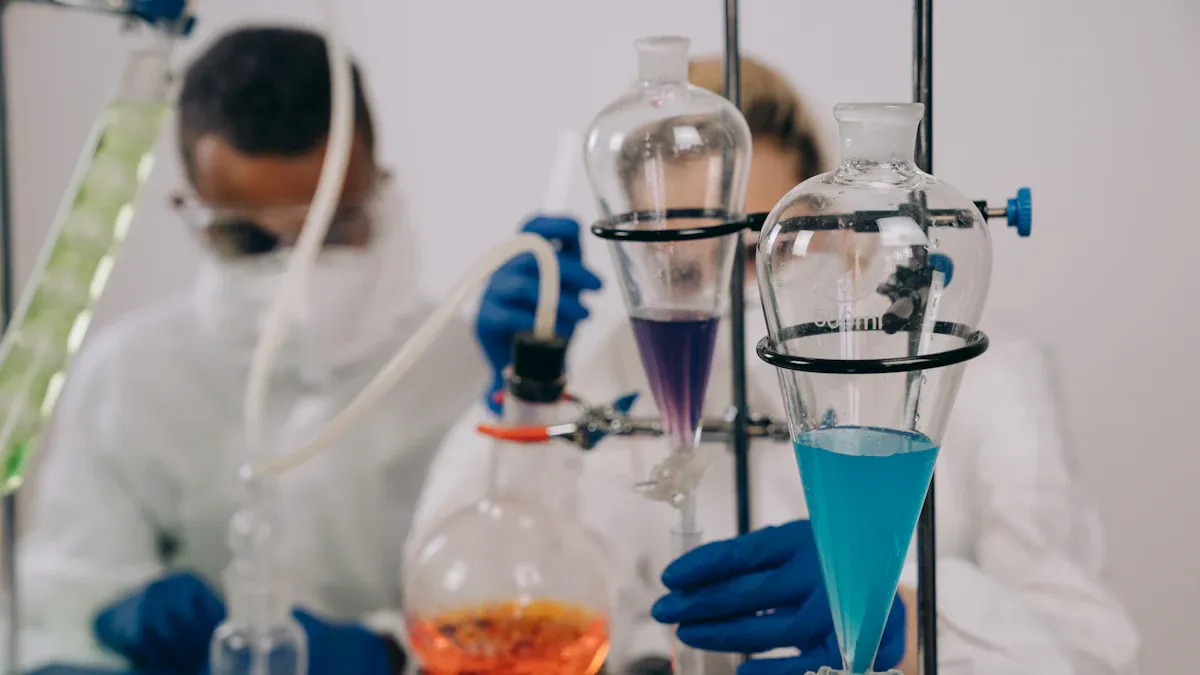
A scientist watches the reaction with fumaric acid and Baeyer’s reagent. The purple color starts to fade. The solution turns brown. This shows the reaction has begun. Manganese dioxide forms as a brown solid. The scientist knows the double bond has reacted. Next, the scientist separates the products. They use filtration to remove manganese dioxide. The liquid left has the new diol. The scientist checks the liquid for tartaric acid. They use melting point tests. Racemic tartaric acid melts at a certain temperature. The scientist compares this to known numbers. They also do stereochemistry tests. These tests show two chiral centers in the acid. The scientist proves racemic tartaric acid was made.
Note: Always test melting point and stereochemistry to confirm products. These tests help you avoid mistakes.
Common Pitfalls
Many students get confused about the reaction result. Some think meso-tartaric acid is made. The trans configuration of fumaric acid stops this. Only racemic tartaric acid forms here. Others mix up this reaction with diels-alder. The diels-alder reaction makes rings. Baeyer’s reagent does not make rings. It adds hydroxyl groups to the double bond. Stereochemistry is very important. The scientist must check the acid’s configuration. Wrong guesses cause mistakes in finding products. The table below lists common mistakes and ways to avoid them:
| Mistake | How to Avoid |
|---|---|
| Confusing meso and racemic acid | Check the trans configuration |
| Mixing up reaction types | Study the stereochemistry and outcome |
| Ignoring chiral centers | Use stereochemistry tests |
A scientist who knows stereochemistry and the steps avoids these mistakes. Careful watching and testing give correct results.
Fumaric acid mixes with Baeyer’s reagent. This makes a diol called racemic tartaric acid. This reaction shows how a double bond can change an acid. Students learn about these changes in organic chemistry class. They study many types of reactions. The table below gives another example:
| Reaction Type | Description |
|---|---|
| Baeyer-Villiger Reaction | This reaction uses peroxycarboxylic acid to change an aldehyde or ketone. It makes a carboxylic acid or ester. |
Students use this knowledge in the lab. They learn how to spot chemical changes. These skills help them with future experiments and studies.
FAQ
What is Baeyer’s reagent?
Baeyer’s reagent has potassium permanganate mixed in water. Chemists use it to find double bonds in molecules. The purple color goes away when a reaction happens.
Why does the solution turn brown during the reaction?
The solution turns brown because manganese dioxide appears. This means the double bond in fumaric acid reacted with Baeyer’s reagent.
How can someone confirm the product is racemic tartaric acid?
Scientists test the melting point and check stereochemistry. These tests show two chiral centers. The results match racemic tartaric acid’s known features.
What is the difference between racemic and meso-tartaric acid?
| Racemic Tartaric Acid | Meso-Tartaric Acid |
|---|---|
| Has two mirror-image forms | Has a symmetry plane |
| Not the same as its mirror image | Can match its mirror image |
Can this reaction happen with maleic acid?
Maleic acid reacts with Baeyer’s reagent, too. It makes meso-tartaric acid because it has a cis configuration. Fumaric acid makes racemic tartaric acid because it has a trans configuration.