The fumaric acid market is growing fast. This is because more people want it in food and drinks. Companies see new chances as people want easy and natural foods. The table below shows the market size and how much it may grow:
| Year | Market Size (USD Million) | CAGR (%) |
|---|---|---|
| 2024 | 799.2 | N/A |
| 2025 | 846.3 | 5.9 |
| 2035 | 1500 | 5.9 |
- Eating more processed food makes people buy more.
- Making fumaric acid costs a lot, so prices go up.
- Changes in the market bring problems and new chances for users.
Key Takeaways
- The fumaric acid market is growing fast. This is because more people want processed foods and drinks. Fumaric acid is mostly used as a food additive. It helps make food taste better. It also helps keep food fresh. Sustainability is very important now. Companies are starting to use bio-based fumaric acid. This helps meet eco-friendly needs. The pharmaceutical industry uses a lot of fumaric acid. They use it to make medicines. New markets in Asia-Pacific and Latin America are helping the market grow. These places are making the fumaric acid sector bigger.
Fumaric Acid Market Overview

Market Size and Growth
The global fumaric acid market is growing fast. In 2025, it may be worth about USD 591.8 million. By 2035, it could reach USD 1,142.6 million. The CAGR from 2023 to 2035 is 6.8%. Another report says the market will be USD 737.1 million in 2025. It could grow to USD 1,200 million by 2035. This report shows a CAGR of 5.0%.
In the last five years, the fumaric acid industry got bigger. People want more processed and easy foods. The food additive segment brings in the most money. Fumaric acid helps control acidity and keeps food fresh. It also makes food taste better. But making fumaric acid costs a lot for companies.
The food and beverage sector helps the market grow. More people want food with fumaric acid additives. The pharmaceutical segment is also growing fast. Companies use fumaric acid to make medicine.
Key Market Segments and Their Impact on the Fumaric Acid Industry
The fumaric acid market has many important parts. Each part helps shape the industry in its own way.
| Segment Type | Segment Name | Revenue Contribution (%) | Growth Rate (CAGR) |
|---|---|---|---|
| Application | Food Additive | 65.5% | N/A |
| Application | UPR (Unsaturated Polyester Resins) | N/A | Fastest growth 2025-2032 |
| End-User | Food and Beverages Industry | 45.4% | N/A |
| End-User | Pharmaceutical Industry | N/A | Fastest CAGR 2025-2032 |
| Extraction Type | Maleic Anhydride | Largest revenue share | N/A |
The food and beverage sector is the biggest part of the market. It has 45.4% of the market share in 2024. More people want processed and packaged foods. This means more fumaric acid is used as a food additive. The pharmaceutical industry is growing the fastest. Companies use fumaric acid to make health products and medicine.
Other parts of the market are UPRs, animal feed, and cosmetics. UPRs are growing fast because of building projects. Animal feed uses fumaric acid to help animals get better nutrition.
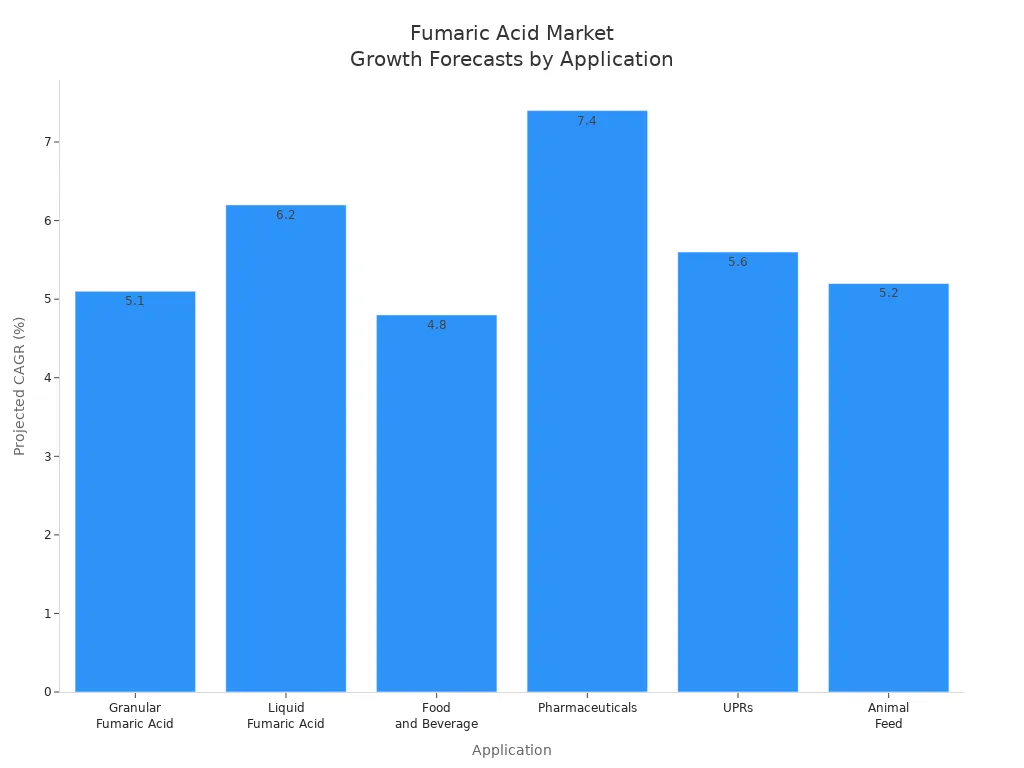
Regional trends also affect the fumaric acid market. Asia Pacific makes and uses the most fumaric acid. China and India have many factories and a big food sector. Latin America wants more processed foods and drinks. The Middle East and Africa are growing in food processing and industry.
| Region | Key Factors Influencing Trends |
|---|---|
| Asia Pacific | Rapid industrialization in China and India; growth in food and beverage sector; focus on bio-based chemicals |
| Latin America | Rising demand for processed foods and beverages; growing economy and consumer base; adoption of bio-based technologies |
| Middle East & Africa | Increasing industrial activities; growing food processing industry; demand for food preservation and coatings |
The additive segment is very important for the fumaric acid market. Fumaric acid as a food additive helps the food and beverage sector. It meets the need for safe and tasty foods. The pharmaceutical segment keeps growing as new medicines are made.
Trends in the Industrial Grade Fumaric Acid Market
Industrial Applications
The industrial grade fumaric acid market helps many industries. Companies use this compound in lots of ways. The table below lists the main sectors and their uses:
| Application Sector | Description |
|---|---|
| Food and Beverage | Used as an acidulant and flavoring agent in products like carbonated beverages, fruit juices, and candies. |
| Pharmaceuticals | Essential for producing antihistamines and antimalarials; used in treatments for psoriasis. |
| Polymer Production | Key raw material in unsaturated polyester resins, utilized in automotive and construction industries. |
| Textile Industry | Acts as a mordant to improve dye adherence and colorfastness in natural dyes for fabrics. |
| Paper Manufacturing | Component of paper sizing agents to enhance surface properties and printability. |
| Printer Toner Production | Contributes to the development of fine, uniform powder for laser printers and photocopiers. |
| Renewable Energy Production | Emerging interest in sustainable production methods, particularly microbial fermentation. |
In the past, companies mostly used industrial grade fumaric acid market in food and drinks. Now, more industries use it for other things. Polymer production is now a big part of the market. Manufacturers use it to make unsaturated polyester resins. These resins help build cars and buildings. The textile industry uses it to help dyes stick to fabric. Paper companies add it to make paper better for printing. Printer toner makers use it to make fine powders for printers. New trends show renewable energy companies are starting to use industrial grade fumaric acid market in green ways.
Key Demand Drivers in Industrial Grade Fumaric Acid
Many industries need industrial grade fumaric acid market, so the market grows. The food and beverage industry is a big reason for this. People want more foods that are easy to eat and last longer. This makes companies use more industrial grade fumaric acid market as a food additive. In 2024, the food and beverage sector has a large share of the market. It makes up about 45.4% of the total market. Consumers want foods that stay fresh. Companies use industrial grade fumaric acid market to help with this.
Other industries also need industrial grade fumaric acid market. The pharmaceutical industry uses it to make medicine. Polymer producers need it for resins in cars and buildings. Textile companies use it to make dyes work better. Paper makers add it to improve printing. Printer toner makers use it for high-quality powders. Renewable energy companies are starting to use it for new green methods.
Note: The industrial grade fumaric acid market has some problems. Making it can cost a lot. Companies must follow strict safety and quality rules. Some industries want greener ways to make industrial grade fumaric acid market. These trends push companies to find cheaper and better ways to produce it.
The industrial grade fumaric acid market will probably keep growing. More industries find new ways to use this compound. Companies that watch these changes can find new chances to grow.
Fumaric Acid Industry Segmentation
Application-Based Market Segmentation
The fumaric acid industry helps many businesses. Companies use fumaric acid in food, paper, and plastics. Food additives are the biggest part of the market. Many food and drink companies use fumaric acid. They use it to make food taste better and keep it fresh. It also helps control pH in foods. The table below shows how much each segment uses fumaric acid:
| Application Segment | Market Share |
|---|---|
| Food Additives | Largest market share |
| Rosin-sized Sheathing Paper | N/A |
| Unsaturated Polyester Resins | N/A |
| Alkyd Resins | N/A |
| Others | N/A |
- Food and beverage processing is growing very fast.
- Food and drinks will likely stay the biggest users.
Segmentation by Form and Source
Fumaric acid comes in different types and from different places. Most fumaric acid is synthetic and made from maleic anhydride. This kind is popular because it costs less and is easy to make. Bio-based fumaric acid is made by fermentation. More people want green products, so this type is growing quickly.
- Maleic anhydride had the most revenue in 2024.
- Fermentation is expected to grow fastest from 2025 to 2032.
- Food and drinks use the most fumaric acid.
- The pharmaceutical industry is using more, especially in new markets.
- New rules and trends make companies use more bio-based fumaric acid.
Regional Analysis
Different places have their own trends in the fumaric acid market. Asia-Pacific grows the fastest because of more factories and lots of people. North America wants more processed foods and green products. Europe has strong rules for clean food and bio-based chemicals.
| Region | Growth Factors |
|---|---|
| North America | More processed foods, dietary supplements, and sustainable polymer resins. |
| Asia-Pacific | Fast industrial growth, rising population, and higher demand for processed foods and beverages. |
| Europe | Strong rules for clean-label foods and bio-based chemical production. |
Note: Rules are different in each region. Some Asian countries let more fumaric acid in foods than Western countries. Global companies must follow many rules to sell everywhere. Groups like the EPA and WHO want eco-friendly production. Governments in Asia-Pacific and North America help with bio-based chemicals.
Tech Advances in the Fumaric Acid Industry
Technological Innovations in Fumaric Acid Production
The fumaric acid industry uses new technology now. Companies have found better ways to make fumaric acid. These new ways help save money and energy. Some of the latest changes are:
- New ways to make fumaric acid use renewable resources.
- Biotechnological processes make production faster and cheaper.
- Some methods use LEDs to help start chemical reactions.
- In-line NMR analysis helps companies check reactions quickly.
- Flow reactors let companies make more product faster and change plans easily.
Automation and artificial intelligence are important in factories today. Automated systems help stop mistakes and use resources better. AI tools can guess how much raw material is needed. This helps save energy. Machine learning helps scientists find new products faster. AI can also help companies know how much to make. This means less waste.
Sustainability and Environmental Impact
Making fumaric acid in a green way is very important now. Many companies want to use bio-based fumaric acid. This helps meet rules and what customers want. Using bio-based methods means less fossil fuel is used. It also lowers carbon emissions. Microorganisms like Rhizopus oryzae and Aspergillus niger help turn renewable carbon into fumaric acid. Genetic engineering makes these methods work even better. It helps companies get more product and make less waste.
Manufacturers also use fermentation to help the environment. These green ways use waste biomass as a resource. More people want clean-label products, so bio-based fumaric acid is popular. Strong food safety rules also make companies use more bio-based fumaric acid. Companies that use green methods can attract eco-friendly buyers and do better in the market.
Note: Green ways to make fumaric acid help the planet and help the industry grow for a long time.
Strategic Insights and Recommendations
Emerging Opportunities and Growth Prospects in the Fumaric Acid Market
The fumaric acid industry keeps finding new ways to grow. Many things help the market look good:
- More people want fumaric acid in food. Processed foods use it to make food taste better and last longer.
- Sustainability is important for the future. Companies now try to make fumaric acid in eco-friendly ways and use biodegradable options.
- The food and beverage sector uses fumaric acid to keep food fresh. More people and changing tastes make this use go up.
- Cities are getting bigger and people are busier. This means people eat more processed foods. So, the need for fumaric acid goes up to help food stay good and last longer.
Looking closer at market trends shows more chances for businesses:
| Market Trend | Description |
|---|---|
| Food & Beverage Processing | Fumaric acid helps keep food stable and makes it taste better. |
| Increase in Demand for Sports and Health Drinks | Drinks for health use fumaric acid, giving companies new chances. |
| Rising Clean Label Trends | People want natural and clean ingredients, so they buy more products with fumaric acid. |
People keep buying more processed foods and drinks. This helps companies use fumaric acid to make food taste better and last longer. Businesses that follow these changes can find new ways to grow.
The fumaric acid market is growing fast. People want it for food, medicine, and cosmetics. Companies use new technology to do better. They also choose natural ingredients to get ahead. The table below shows ways to study the market for better planning:
| Analysis Type | Description |
|---|---|
| Porter’s Five Forces | Looks at how the industry works and plans. |
| PESTEL Analysis | Checks rules and money issues. |
| Regional Analysis | Follows sales and trends in each place. |
Experts think the market will get bigger soon. Cities are growing and new uses in building and cars help. Businesses should watch for changes and use smart planning to find new chances.
FAQ
What is fumaric acid used for?
Fumaric acid makes food taste better and last longer. Companies put it in drinks, candies, and baked goods. It is also used to make medicines and plastics.
Is fumaric acid safe to eat?
Experts say fumaric acid is safe in small amounts. Groups like the FDA allow it in food products.
Tip: If you have allergies, check food labels for additives.
How do companies make fumaric acid?
Most companies make fumaric acid from maleic anhydride. Some use fermentation with special microbes to make bio-based fumaric acid.
| Method | Description |
|---|---|
| Chemical | Uses maleic anhydride |
| Biological | Uses fermentation |
Which countries use the most fumaric acid?
China and India use the most fumaric acid. These countries have many factories and a big food industry.
Can fumaric acid help the environment?
Bio-based fumaric acid helps cut down pollution. Companies use green ways to lower carbon emissions and waste.
Note: Buying products with bio-based fumaric acid helps the planet.