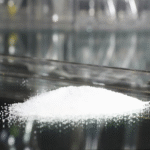
Fumaric acid (C₄H₄O₄, E297) is a dicarboxylic acid naturally found in fruits, mushrooms, and lichen—and produced endogenously in human cells as part of the Krebs cycle. As an organic acid, it is chemically and structurally unrelated to gluten, which is a composite of storage proteins (gliadin and glutenin) found in wheat, barley, and rye. The U.S. Food and Drug Administration (FDA) recognizes fumaric acid as Generally Recognized as Safe (GRAS) for use as a flavoring agent and pH control agent (21 CFR 172.350), and the European Food Safety Authority (EFSA) lists it as approved additive E297 under Commission Regulation (EU) No 231/2012. For individuals with celiac disease or gluten sensitivity, fumaric acid presents no gluten exposure risk when sourced from reputable manufacturers following Good Manufacturing Practices (GMP).
Key Takeaways
- Fumaric acid (C₄H₄O₄, E297) is a gluten-free organic acid — its chemical structure has no relation to wheat, barley, or rye proteins.
- Global regulators (FDA GRAS, EFSA E297, JECFA ADI “not specific”) confirm its safety for food use at current consumption levels. The gluten threshold across FDA/Codex/EU/Health Canada is ≤20 ppm (mg/kg).
- Fumaric acid is manufactured via two routes — catalytic isomerization of maleic acid and glucose fermentation by Rhizopus species — neither of which introduces gluten-containing raw materials.
- As the strongest common organic food acid (~1.5x the sourness of citric acid), it is widely used in gluten-free tortillas, dry mixes, and baked goods for leavening and pH control.
- JECFA has set an ADI of 6 mg/kg body weight/day. For a 68 kg (150 lb) adult, this equates to ~408 mg/day — far above typical dietary intake.
Is fumaric acid gluten free
Sources: Single comprehensive table distinguishing synthetic (maleic anhydride → maleic acid → catalytic isomerization) and natural (fermentation by Rhizopus oryzae / Aspergillus niger on glucose substrates). Add a “Cross-Contamination Risk” column: “None — neither hydrocarbon feedstock nor fungal fermentation media contain wheat, barley, or rye derivatives.”
Manufacturing: Consolidate into one detailed process narrative (not three shallow tables). For isomerization: maleic anhydride (from butane) → hydrolysis to maleic acid → catalytic isomerization (heat + catalyst) → crystallization → fumaric acid. For fermentation: glucose/carbohydrate substrate → Rhizopus fermentation → downstream separation. Note that neither pathway introduces gluten.
Gluten Free Status: One definitive opening statement backed by citations: “Fumaric acid is gluten-free by chemical definition and by regulatory standard. It is an organic acid (C₄H₄O₄), not a protein, and contains no wheat, barley, rye, or crossbred grain derivatives.” Then reference specific celiac organizations by name (e.g., Celiac Disease Foundation, Beyond Celiac, Coeliac UK, Gluten Intolerance Group) with links. Regulation table with hyperlinked ppm values to source documents.
Fumaric acid in food

Uses: Retain the strong application table. Add a comparison table: fumaric acid vs. citric acid vs. malic acid vs. tartaric acid — sourness intensity (1.5x vs. 1.0x vs. 0.8x vs. 0.7x citric equivalent), hygroscopicity (none vs. high vs. moderate vs. low), solubility (0.5g/100mL vs. 59g/100mL vs. 55g/100mL vs. 133g/100mL). This is a key differentiator that competitors partially cover.
Safety: Clearly separate food-grade fumaric acid safety from pharmaceutical fumarate ester safety. Food-grade: FDA GRAS, EFSA E297, JECFA ADI “not specific.” Pharmaceutical: DMF (Tecfidera) and MEF used for psoriasis — associated with flushing, GI disturbances, lymphocytopenia — entirely different dosage, route, and risk profile. Add: “These side effects are associated with pharmaceutical-grade fumaric acid esters at therapeutic doses, not with the trace amounts of fumaric acid used as a food additive.”
Dietary: Expand to a proper dietary compatibility table: Vegan (✓, no animal derivatives), Vegetarian (✓), Halal (✓, MUI-certified suppliers available), Kosher (✓, pareve certification common, Passover options available), Gluten-Free (✓, by chemical definition + regulatory standard), Major Allergens (none — no milk, eggs, fish, shellfish, tree nuts, peanuts, wheat, soybeans).
FAQ
Is fumaric acid gluten-free?
Fumaric acid (C₄H₄O₄) is an organic acid, not a protein. It is chemically incapable of containing gluten, which is a composite of storage proteins (gliadin + glutenin) found exclusively in wheat, barley, and rye. Both major manufacturing routes (chemical synthesis from maleic anhydride and fermentation from glucose) use gluten-free raw materials. FDA classifies products with <20 ppm gluten as gluten-free — food-grade fumaric acid falls well below this threshold.
Is fumaric acid natural?
Fumaric acid occurs naturally in fumitory (Fumaria officinalis), bolete mushrooms, lichen, Iceland moss, apples, and watermelon. It is also produced endogenously in human cells as part of the Krebs (citric acid) cycle. Commercially, most fumaric acid is produced synthetically via isomerization of maleic acid; however, fermentation-based production using Rhizopus species on glucose substrates yields a product chemically identical to the naturally occurring form.
Is fumaric acid vegan?
Neither manufacturing route (chemical synthesis or fungal fermentation) involves animal-derived raw materials, processing aids, or derivatives. Fumaric acid is suitable for vegan and vegetarian diets.